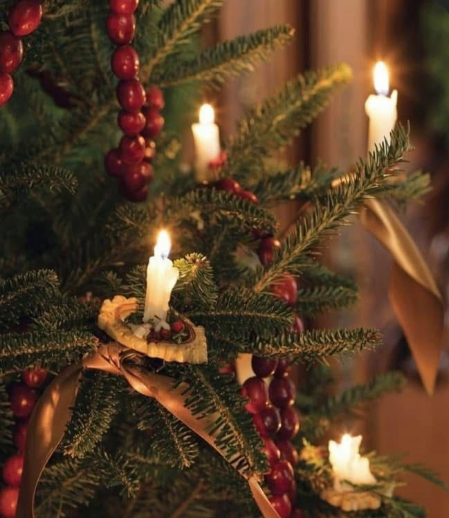

Every December the Christmas tree is a holiday staple in nearly every home, and a favorite in nearly every heart. Who doesn’t love the sight of a beautiful Christmas tree, sparkling in the night, offering glittering hope through cheerful windows from the street, and carrying its message of Christmas joy throughout the season?
For many of us, Christmas trees bring back dozens of memories. I can remember playing “I Spy on the Christmas Tree” with my siblings late into the night and in the early morning hours every December. For my mother, the day after Thanksgiving is her favorite day to put up the Christmas tree, and it’s often an exciting and beautiful way for us to gather together and celebrate the transition from Thanksgiving to Christmas, complete with Christmas music of course! We laugh over familiar ornaments, tell stories, and remember good times and old friends. It’s a peaceful day after the busy cooking and baking of Thanksgiving week, and many of us look forward to it every year.
From pets to kids, from outdoor trees to indoors trees, there are so many ways that Christmas trees are woven into our Christmas memories in beautiful and meaningful ways.
But what is the history of the Christmas tree? Let’s turn now to discover 7 facts about the history of Christmas trees and why this special emblem has such an important place in the Christmas season today.
The Hidden History of the Christmas Tree

1. The First Trees Were Placed in Homes 1,000 Years Ago

Over 1,000 years ago, winters were tough for the Vikings in Scandinavia. They were dark, depressing, and deadly. The evergreen, in contrast, stood as a beacon of hope, as they were able to stand the test of the deadliest winters and outlast the strongest men. In reverence (though not necessarily worship), the Vikings began to chop down evergreen trees and place them in their homes as inspiration throughout the winter season. Other Europeans began practicing this tradition as well, and some even incorporated them into pagan religious practices.
2. A Monk Gave the Christmas Tree Important Meaning

St. Boniface, a monk from Crediton, Devonshire, England, traveled across Europe as a missionary in the seventh century. Legend goes that St. Boniface stumbled across a group of men gathering around an oak tree who were preparing to sacrifice a little boy to the god of Thor. Boniface protested and demanded they stop, striking his fist on the tree. To everyone’s shock the evergreen tree immediately fell over and crashed onto the forest floor. Where it had fallen, a tiny fir tree stood. Boniface used the little tree as an illustration for the Tree of Life.
As the story goes, “He told them that the tree even winter could not kill stood for the eternal life offered to them by Christ. Finally he pointed to the triangular shape of the tree and stated that the fir’s three points represented the Holy Trinity of God the Father, Son, and Holy Ghost. Each of the men supposedly gave their lives to Christ at the spot where the evergreen grew” (Collins, 71).
After 500 years, this story had become a well-known legend throughout Germany and France. Evergreen trees were hung from ceilings as a symbol of Christianity for the next 200 years, adding another chapter to the history of the Christmas tree.
3. Paradise Trees & the Catholic Church

Evergreen trees in Europe were placed outside Catholic Churches in the months of December during the Dark Ages. Referring to them as “paradise trees,” the clergy used them to explain to children the story of Adam and Eve. Apples were hung on the trees to represent the fruit of knowledge—an early symbolic use in the history of Christmas tree lights and decorations.
4. Christmas Trees Lose Popularity for a Time

Princess Helene de Mecklembourg, who was familiar with the use of Christmas trees, married the Duke of Orleans in 1521 and introduced the Christmas tree to Paris, France. However, the practice of placing Christmas trees in homes lost any momentum by the late 1500s. By that time, trees were more associated with throwbacks to pagan rituals rather than having any sort of Christmas significance—until Martin Luther changed Christmas tree history forever.
5. The Surprising Truth Behind Martin Luther’s Influence on Christmas

The legend goes that German Protestant Reformer Martin Luther was walking home in the dark one December evening when he was struck by the dazzling beauty of the night sky. Starlight shown beautifully through the evergreen trees around him, and he desired to capture that same beauty and place it in his home.
He secured a candle and candleholder on one of the branches of the trees in his home and lit the wick. He liked it so much that he added a few more to the tree. Pretty soon, Luther’s family and neighbors were enchanted by the flickering beauty in Luther’s home and began doing the same. And so, “The tradition of a lighted tree was born”! (Collins, 73).
Luther told his friends and family that the Christmas tree was a symbol of God’s never-ending love. He explained that just like the evergreen tree stays green all year, God’s love stays strong no matter what happens. In regards to the history of Christmas tree lights, the candlelight on the tree represented the hope that Jesus brought into the world through His birth and resurrection.
It should be noted that there are some minor variations to this story and how Luther influenced the history of Christmas trees.
6. Christmas Trees Become an American Holiday Tradition

The Christmas tree was first brought to America by Germans during the Revolutionary War, but it didn’t catch on right away. In the 1820s, German immigrants in Pennsylvania helped make it more common, but many Americans still saw it as a German tradition and didn’t adopt it. That changed in 1841 when Prince Albert of Germany, married to Queen Victoria of England, set up a Christmas tree at Windsor Castle. A picture of their tree was later published in American newspapers, and it helped popularize the tradition just as Americans were becoming more open to celebrating Christmas.
In the years leading up to the Civil War, Americans began embracing the Christmas tree as part of the holiday spirit. Wealthy families and the middle class loved the idea, and even poorer households joined in by cutting down free cedar trees from nearby fields. It became a celebrated tradition that people of all backgrounds could share.
7. From Forest to Marketplace: The Rise of Christmas Tree Lots

Before 1851, people had to cut down their own Christmas trees, which was easy in rural areas but nearly impossible for city dwellers. That changed when Mark Carr brought trees from the Catskills to New York City and sold them in a lot. His idea took off, and soon tree lots appeared in cities across America and even Europe.
By the 1880s, Christmas trees were so popular that people worried fir trees might disappear. This led to the creation of artificial Christmas trees made from feathers or brushes. Though it took time, these artificial Christmas trees caught on and are extremely popular to this day.
The History of Christmas Trees is Full of Surprises

Now you know the history of Christmas trees! It’s surprising to think that the roots of this important Christmas tradition date back 1,000 years ago. From a wild story of a Monk converting Vikings in the forests, to upside down trees hung from ceilings, to Martin Luther on a relaxing stroll in the woods, the history of Christmas trees is surprising and has remained unknown by most people today who choose to celebrate every year with this important emblem of hope.
Growing up, I heard many people explain that the Christmas tree is a symbol of Christ and his sacrifice on the cross, as the cross was made from wood from a tree. While I don’t know how accurate this interpretation is historically, I like it nonetheless! It’s a great reminder of what the birth of Christ ultimately accomplished.
As we look back on the history of the Christmas tree, we wonder in awe how two monks had an enormous impact on this important Christmas tradition, helping turn it into what it is today.

Source:
*SOURCE: “Stories Behind the Great Traditions of Christmas” by Ace Collins (chapter 9).

Leave a Reply